
Shopify remains the default answer when someone asks how to start selling online, and its 2026 pricing page leans harder into AI than ever — a built-in “Sidekick” assistant, AI storefront generation, and a free “Agentic” plan for selling directly inside AI chat apps. The core product is still the same: hosted ecommerce, a drag-and-drop store builder, and an increasingly aggressive push into payments, banking, and business funding alongside the storefront itself.
On this page
Quick Verdict
| Overall Rating | 4.4/5 (G2, ~5,000+ reviews) — see the ratings note below |
| Best For | Anyone who wants a hosted, reliable store without managing their own infrastructure |
| Starting Price | $29/month (Basic, billed annually) |
| Free Trial | 3 days, no credit card, then $1/month for 3 months before standard pricing kicks in |
| Transaction Fees | 2.9% + 30¢ (Basic) down to 2.25% + 30¢ (Plus) with Shopify Payments; extra fee if using a third-party processor |
| Cancellation | Cancel anytime, except Plus (1- or 3-year term commitment) |
Pros & Cons
Pros
- Store, hosting, checkout, and payments all in one place — no separate hosting or SSL to manage
- Standard card-processing rates fall as you move up plans, and using Shopify Payments avoids Shopify’s additional third-party transaction fee (though the card-processing rate still applies either way)
- 1,000+ apps in the Shopify App Store cover almost any feature gap
- Sidekick AI assistant and AI storefront generation included from the entry-level Basic plan
- PCI DSS Level 1 compliant by default — payment security isn’t something you configure yourself
- A free “Agentic” option lets you list products for AI shopping channels and pay only when you make a sale
Cons
- Basic includes no additional staff accounts beyond the owner — you’re paying $79/month (Grow) before you can add a teammate
- Checkout customization is limited until Plus, which starts at $2,300/month
- Monthly billing costs noticeably more than annual — Basic jumps from $29 to $39/month if you don’t commit annually
- Shopify’s Trustpilot rating (around 1.3/5) is far below its G2 and Capterra scores (4.4–4.5/5), but the review pools aren’t measuring quite the same thing — a meaningful share of Trustpilot reviews are shoppers complaining about individual Shopify-powered stores rather than about Shopify itself. That said, the same reviews also contain specific, recurring merchant complaints about Shopify Payments holds and billing disputes, which is worth reading before you commit your payment processing to the platform
- Plus starts at $2,300/month, but only on a 3-year term — a 1-year term costs $2,500/month, and more complex setups get a variable, custom-quoted fee
Ready to try Shopify ?
Who Should Use Shopify?
Shopify suits anyone who wants to start selling — online, in person, or now in AI chat channels — without running their own servers or stitching together separate hosting, checkout, and payment tools. It scales reasonably well from a single-founder store on Basic through to multi-location retail with staff accounts and POS hardware on Grow and Advanced, and up to high-volume, highly customized checkouts on Plus. The built-in Shopify Balance, Shopify Credit, and Shopify Capital options also make it a reasonable fit if you’d rather keep banking, a business card, and funding inside the same dashboard as your store.
It’s a weaker fit if you need more than one staff login on a tight budget (Basic doesn’t include any), if full checkout customization matters before you’re doing Plus-level volume, or if the merchant-side billing and payment-hold complaints documented on Shopify’s Trustpilot page are a dealbreaker for how comfortable you are trusting a platform with your payment processing.
Don’t need full ecommerce? If you just want a simple content or portfolio site without Shopify’s commerce-focused toolset, see our guide to the best website builders.
Key Features
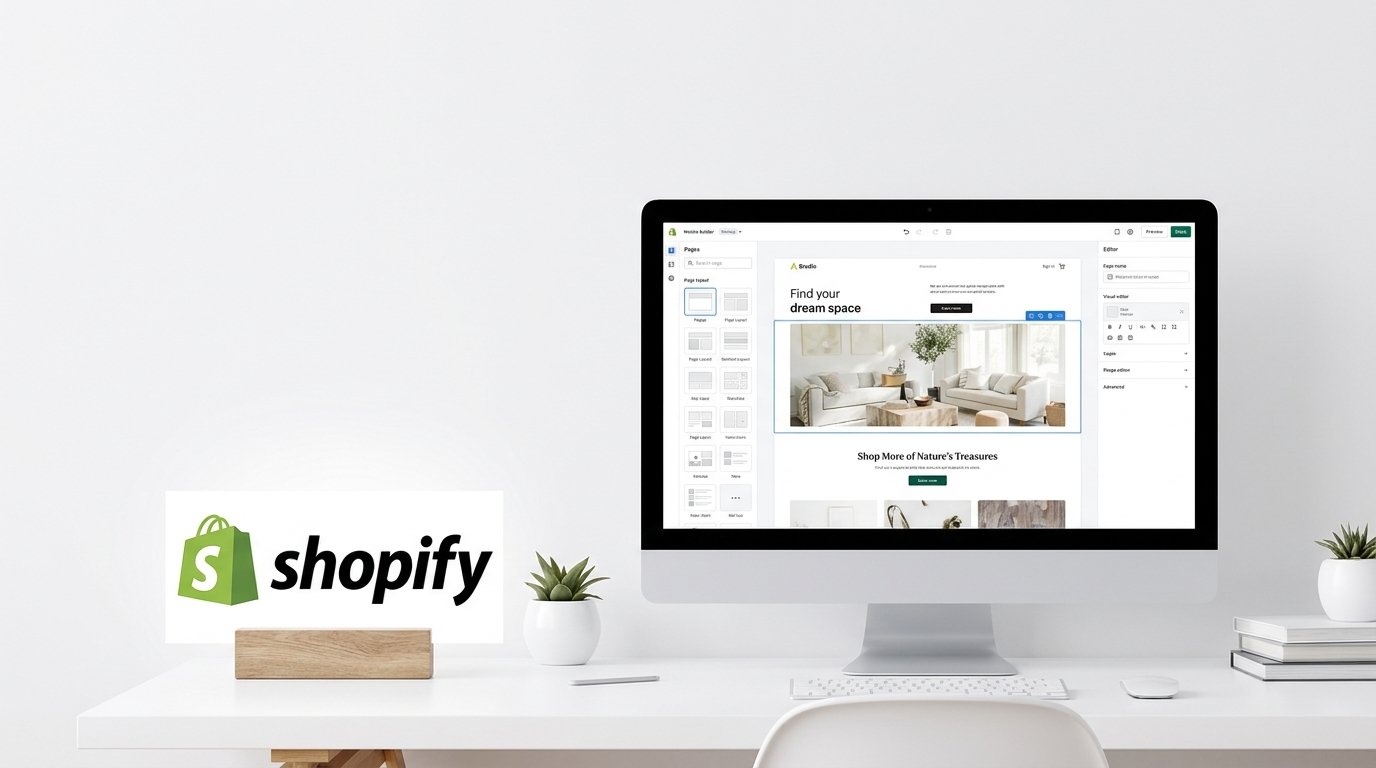
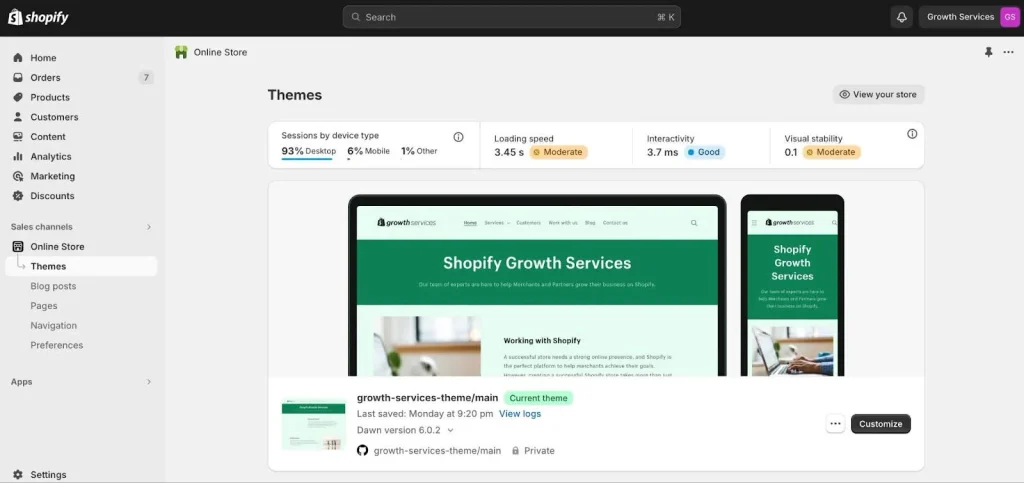
Store Builder and Hosting. Unlimited products, unlimited web hosting, and a free SSL certificate are included on every paid plan. You can connect a domain you already own, or purchase a new one separately — domain registration isn’t bundled into the subscription. The website builder can generate a store from a prompt or a template. Shopify’s own pricing page claims its checkout converts about 15% better on average than other platforms, based on its cited study.
Sidekick AI Assistant. An AI assistant built into every plan, including Basic, described as “commerce-obsessed” — it’s positioned to help with store setup, content, and day-to-day store management, with “millions of tokens” included regardless of plan.
Selling Channels. Every plan supports selling online, on social platforms and marketplaces, in person, and in AI chats through Shopify’s agentic commerce tooling. A separate “Agentic” plan exists specifically for listing products in Shopify’s Catalog for AI shopping channels, with no monthly subscription fee. Transaction and payment-provider fees still apply to sales (from 2.9% + 30¢ online), and additional costs can apply if you use paid apps or services.
Payments and Transaction Fees. Shopify Payments is built in, with online standard card rates starting at 2.9% + 30¢ on Basic and dropping to 2.25% + 30¢ on Plus. If you use a different payment processor instead, Shopify charges its own fee on top — 2% on Basic, dropping to 0.2% on Plus.
Inventory and Staff. All plans include inventory management across up to 10 locations (200 on Plus). Basic includes no additional staff accounts; Grow adds 5, Advanced 15, and Plus unlimited.
Shipping and Fulfillment. Every plan includes discounted shipping labels, with the discount (up to 87% off) varying by plan, location, carrier, and shipment. Shipping insurance is available where eligible and requires Shopify Payments. Live third-party calculated shipping rates aren’t included on Basic, are available as an add-on on Grow, and come included from Advanced up.
Other notable features
- Shopify Balance, Credit, and Capital are available to eligible merchants, with eligibility depending on business location (Balance and Credit currently require a US or Puerto Rico business). Shopify Balance currently advertises a variable earnings reward — not interest — of 2.29% on Basic/Grow/Advanced and 3.32% on Plus; Shopify Credit offers up to 3% cashback in a qualifying spend category; Shopify Capital provides revenue-based funding in supported countries
- 200+ real-time reports and custom analytics on every plan
- B2B selling with up to 3 catalogs (unlimited on Plus)
- Multi-language and multi-currency selling through Shopify Markets, with local payment methods and automatic duty/tax estimation
- POS Pro available as a $89/month-per-location add-on for businesses with physical storefronts
Pricing
Shopify’s headline prices are for annual billing; monthly billing costs more. All figures are current from the official pricing page.
- Basic — $29/month annual ($39/month billed monthly): For solo entrepreneurs. No additional staff accounts, 2.9% + 30¢ online card rate, up to $5,000 in signup credits.
- Grow — $79/month annual ($105/month billed monthly): For small teams. Up to 5 additional staff accounts, 2.7% + 30¢ card rate, up to 87% off shipping, up to $7,500 in credits.
- Advanced — $299/month annual ($399/month billed monthly): For global reach. Up to 15 additional staff accounts, 2.5% + 30¢ card rate, live third-party shipping rates included, region-level store customization, up to $10,000 in credits.
- Plus — $2,300/month on a 3-year term, or $2,500/month on a 1-year term: For complex, high-volume businesses. 2.25% + 30¢ card rate, unlimited staff accounts, fully customizable checkout, up to 200 POS Pro locations, unlimited B2B catalogs, and priority 24/7 phone support. More complex or higher-volume businesses can be quoted a variable platform fee instead. Rather than the standard free trial, eligible merchants get a paid Plus trial at $399/month for 1–2 months; if you take no action before it ends, Shopify automatically enrolls the store in full Plus under the term you selected at setup.
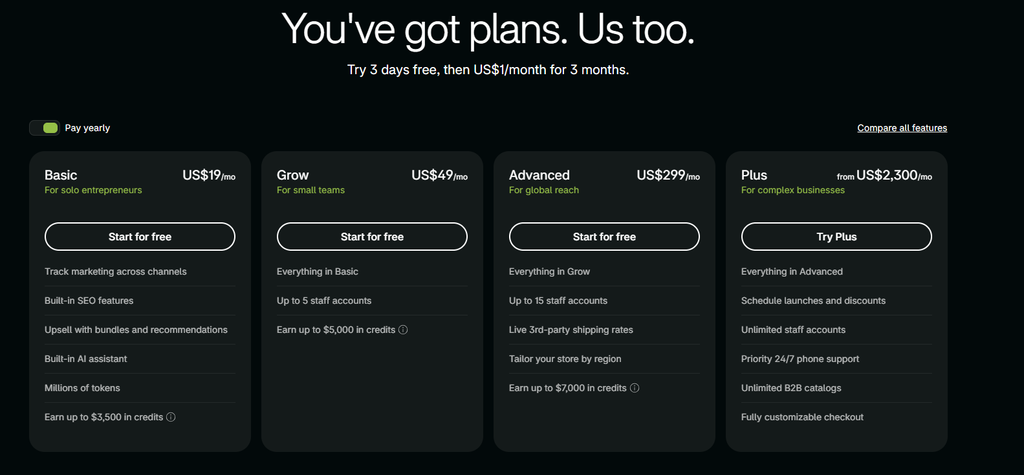
Trial: 3 days free with no credit card, followed by $1/month for the first 3 months, then standard plan pricing.
Refunds and cancellation: Shopify’s subscription fees are generally non-refundable under its Terms of Service, though Support can review billing issues raised within 7 days of a monthly invoice or 30 days of an annual invoice, on a case-by-case basis. Cancelling stops future renewals but doesn’t refund unused time. Plus customers also need to account for their 1- or 3-year term commitment.
Regional note: Prices and card-processing rates above are US figures in USD. Shopify’s pricing, available payment methods, and rates vary by country.
Top Alternatives
If you want a simpler, more design-centric site builder with ecommerce as a secondary feature rather than the core product, Squarespace or Wix are the more common comparisons — both trade some of Shopify’s commerce depth for an easier, more template-driven design experience. If cost and platform ownership matter more than hosted convenience, WooCommerce (built on WordPress) gives you more control and no mandatory platform transaction fee, at the cost of managing your own hosting and updates. BigCommerce is the closest like-for-like competitor for merchants who want Shopify’s breadth of built-in ecommerce tools without Shopify’s specific app ecosystem.
Final Verdict
Shopify earns its reputation as the easiest way to get a real store running without managing your own infrastructure, and its 2026 push into AI tools, agentic commerce, and built-in financial products (Balance, Credit, Capital) makes it more of a full business operating system than a simple storefront builder. The core trade-offs haven’t changed: fees add up if you don’t use Shopify Payments, staff accounts are gated tightly at the entry tier, and Plus pricing requires a sales conversation and a term commitment. The sharp gap between its G2/Capterra ratings and its Trustpilot rating is worth a look too — part of that gap is shoppers rating individual Shopify-powered stores rather than Shopify itself, but the same reviews also contain real, recurring merchant complaints about payment holds and billing that a feature list alone won’t tell you.
FAQ
How much does Shopify cost? Basic starts at $29/month billed annually ($39/month billed monthly), Grow at $79/month annually ($105 monthly), and Advanced at $299/month annually ($399 monthly). Plus starts at $2,300/month with a required 1- or 3-year commitment. A 3-day free trial is available, followed by $1/month for 3 months before standard pricing applies.
Does Shopify charge transaction fees? Not if you use Shopify Payments — you only pay the card processing rate (2.9% + 30¢ down to 2.25% + 30¢, depending on plan). If you use a different payment processor, Shopify adds its own fee on top, ranging from 2% on Basic down to 0.2% on Plus.
Is Shopify good for beginners? Yes — the store builder, hosting, and checkout are designed to work without coding, and the built-in Sidekick AI assistant is included even on the entry-level Basic plan.
Why does Shopify have such different ratings on different review sites? G2 (4.4/5) and Capterra (4.5/5) largely reflect day-to-day merchant product experience — ease of use, features, setup. Trustpilot (around 1.3/5) is a mixed pool: some reviewers are shoppers complaining about an individual Shopify-powered store rather than Shopify itself, which makes it not directly comparable to the other two. But the same Trustpilot reviews also include specific merchant complaints about Shopify Payments account holds and billing disputes, so it isn’t a signal to dismiss outright either.
Can I cancel my Shopify subscription anytime? Yes, on Basic, Grow, and Advanced. Plus requires a 1- or 3-year term, and you can cancel once that term expires.
Can I get a refund from Shopify? Subscription fees are generally non-refundable under Shopify’s Terms of Service. Support can review billing issues raised within 7 days of a monthly invoice or 30 days of an annual invoice, but a refund isn’t guaranteed.
Compare Shopify with
- Hostinger Website Builder
- Squarespace
- Wix
Disclosure: StackDrawer is reader-supported. If you purchase through certain links on this site, we may earn an affiliate commission at no additional cost to you. Learn more in our Affiliate Disclosure.