
Gumroad and Payhip both let you sell digital products with no monthly commitment required, but they structure their fees in almost opposite ways. Gumroad charges one flat rate no matter what you sell or how much you make. Payhip charges more depending on which plan you pick, but every plan — including the free one — gets identical features. Which one is actually cheaper depends heavily on your sales volume and product price.
This comparison breaks down pricing, fees, tax handling, and features to help you figure out which one fits your numbers.
Quick Summary
| Feature | Gumroad | Payhip |
|---|---|---|
| Best For | Standalone digital downloads, simple courses, and memberships | Creators who want identical features at every price point, plus support for physical products |
| Starting Price | $0/month — one flat rate for everyone | $0/month (Free Forever plan) |
| Fee Structure | 10% + $0.50 per direct sale, always | 5% (Free), 2% ($29/mo Plus), or 0% ($99/mo Pro) — no flat per-transaction fee |
| Physical Products | Not supported — digital only | Supported, with inventory tracking (you handle shipping yourself) |
| Tax Handling | Full merchant of record — calculates, collects, and remits sales tax, VAT, and GST worldwide | Automatic EU/UK VAT and US/Canadian sales tax (Quebec QST excepted); other regions are self-managed |
| Affiliate Payouts | Automatic — platform fee splits proportionally between creator and affiliate | Manual — you pay affiliates yourself using Payhip’s monthly reports |
| Course Tools | Basic — no drip scheduling, quizzes, or certificates | More complete — includes quizzes, drip content, and completion certificates |
| Feature Gating | Not applicable, since there’s only one plan | None — every plan, including free, has every feature |
| Rating | ⭐ 4.2 / 5.0 | ⭐ 4.3 / 5.0 |
Quick Recommendation:
Choose Gumroad if you sell higher-priced digital products and want the simplicity of never thinking about which plan you’re on.
Choose Payhip if you sell lower-priced items (its lack of a flat per-transaction fee helps a lot here), want to sell physical products alongside digital ones, or plan to grow into a paid plan that gets your fee down to 0%.
Fees: Do the Math Before You Pick
The two platforms charge fees so differently that “which is cheaper” depends entirely on your price point and volume.
The core structural difference: Gumroad’s fee always includes a flat $0.50 per transaction on top of its 10%. Payhip’s fee is a pure percentage with no flat component at all. That difference matters most on cheap products.
- A $5 sale: Gumroad charges $0.50 + $0.50 = $1.00 — a full 20% of the sale. Payhip’s Free plan charges just 5%, or $0.25. On low-priced products, Payhip is dramatically cheaper simply because it has no flat fee dragging down small transactions.
- A $50 sale: Gumroad charges $5.50 (11%). Payhip’s Free plan charges $2.50 (5%), Plus charges $1.00 (2%), and Pro charges $0.
- The break-even for upgrading Payhip: Payhip’s Plus plan ($29/month) beats Gumroad once your monthly revenue passes roughly $363, and Pro ($99/month, 0% fee) beats Gumroad once revenue passes roughly $990. These are ballpark figures based on revenue alone — the exact break-even shifts with your average order value and transaction count, since Gumroad’s $0.50 fixed fee per sale hits harder with many small transactions than with a few larger ones.
In short: low volume and low prices favor Payhip’s free tier. High volume favors upgrading to a paid Payhip plan. Gumroad’s flat rate is really only competitive in the middle, or for sellers who’d rather not think about upgrading a plan at all.
Feature Comparison
1. Product Types
Gumroad sells digital products — downloads, memberships, subscriptions, pay-what-you-want pricing, and simple courses — plus digital services like freelancing, coaching, and tip jars (services require your account to be at least 30 days old with a prior payout).
Payhip sells all of that too, plus physical products with inventory tracking and shipping settings — a real point of difference if you sell a mix of digital and physical goods. You’re still responsible for actually packing and shipping physical orders yourself; Payhip doesn’t provide fulfillment.
2. Tax Handling
Gumroad has the simpler story here: since January 2025, it’s a full merchant of record worldwide, automatically calculating, collecting, and remitting sales tax, VAT, and GST everywhere it operates. There’s nothing to configure.
Payhip is strong but more regional: it automatically handles EU/UK VAT and US sales tax, and as of July 2026, Canadian GST/HST and PST too (Quebec QST remains an exception while Payhip completes its registration there). Outside those regions, Payhip will collect tax based on rules you set up yourself, but filing and remitting it is on you.
3. Affiliates
Both platforms let you recruit affiliates, but they handle the money differently. Gumroad automates the whole process — its platform fee is split proportionally between creator and affiliate based on the commission rate you set (1% to 75%, or a flat 10% through Gumroad’s own affiliate network), with cookie windows that differ by path (30 days for affiliates you add yourself, 7 days through the general network).
Payhip tracks affiliate sales and commissions for you, but doesn’t pay affiliates automatically — you pay them yourself using Payhip’s monthly affiliate reports. That’s more manual work if you run an active affiliate program.
4. Course & Content Depth
Gumroad’s course support is basic — you can deliver video and file-based lessons, but there’s no drip scheduling, quizzes, or completion certificates.
Payhip goes further, with quizzes, drip content, and certificates built in — still not as deep as a dedicated platform like Thinkific or Teachable, but more complete than Gumroad’s offering.
Pricing Comparison
Gumroad Pricing
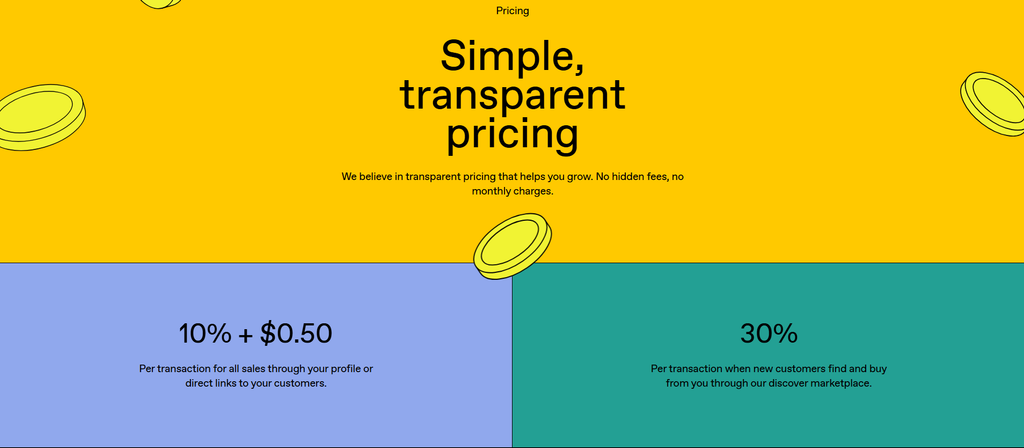
- Direct Sales: 10% + $0.50 per transaction, no monthly fee, no volume discount — the rate never changes regardless of how much you sell.
- Discover Marketplace Sales: 30% per transaction for sales through Gumroad’s organic discovery marketplace, an optional way to reach new buyers.
Payhip Pricing
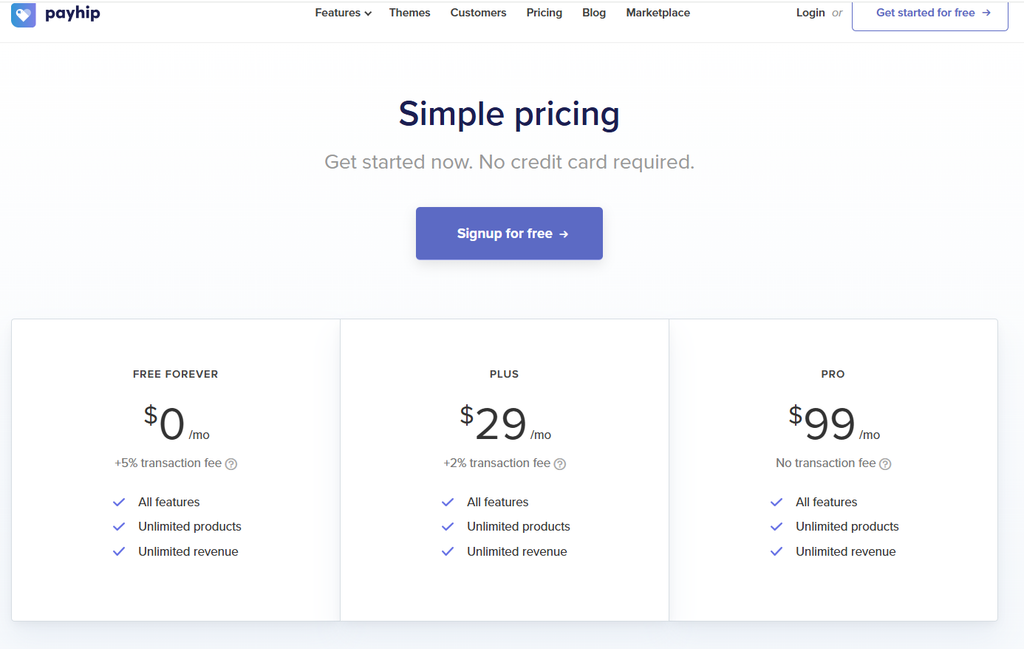
- Free Forever ($0/month): 5% transaction fee, every feature included, unlimited products and revenue.
- Plus ($29/month): 2% transaction fee, same features as Free.
- Pro ($99/month): 0% transaction fee, same features as Free and Plus.
- Standard PayPal or Stripe processing fees apply on top of Payhip’s cut, on every plan — “0% transaction fee” on Pro refers only to Payhip’s own commission.
Which Should you Choose?
Choose Gumroad if:
- You sell higher-priced digital products where the $0.50 flat fee doesn’t meaningfully affect your margin.
- You want to run an affiliate program with automated payouts rather than paying affiliates manually.
- You want the simplicity of one plan, one fee, permanently.
Choose Payhip if:
- You sell lower-priced products, where avoiding a flat per-transaction fee makes a real difference.
- You sell physical products alongside digital ones.
- You’re generating enough consistent revenue that upgrading to a paid plan for a lower percentage makes financial sense.
Final Verdict
Gumroad wins on simplicity — there’s only one number to remember, and its automated affiliate payouts and full global tax handling remove real administrative work.
Payhip wins on flexibility and raw cost for most sellers, especially anyone selling lower-priced products or physical goods, thanks to its lack of a flat transaction fee and its identical-features-on-every-plan structure.
If you’re not sure which fits, run your typical sale price and monthly volume through the math above — for most digital product sellers below roughly $990 in monthly revenue, Payhip’s free tier alone will usually cost less than Gumroad.