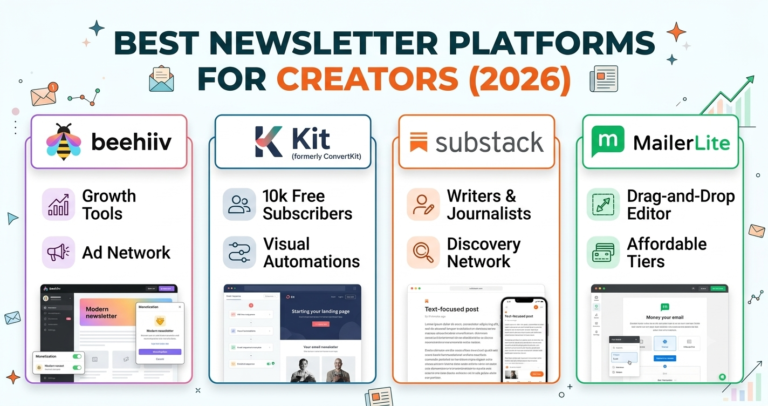

If you are trying to decide between Kit (formerly ConvertKit) and Substack, you are looking at two completely different philosophies of creator monetization.
One is a heavy-duty marketing engine designed to capture leads, run complex sales funnels, and sell digital products. The other is a minimalist publishing platform designed for writers who want a clean, distraction-free space to publish newsletters and collect reader subscriptions.
Here is a direct comparison of their features, automation tools, and pricing models to help you choose the right home for your content.
Quick Summary
| Kit | Substack | |
| Best For | Course creators, coaches, product sellers | Writers, journalists, pure publishers |
| Free Plan Limit | Up to 10,000 subscribers | Unlimited subscribers |
| Starting Price | $39/month (Creator tier) | 100% Free to use |
| Platform / Transaction Fee | 3.5% + $0.30 on built-in products | 10% cut on paid subscriptions |
| Visual Automation | Excellent (Advanced workflows) | None (Broadcasts only) |
| Digital Product Sales | Native (Ebooks, courses, coaching) | Limited (Paid subscriptions only) |
Quick Recommendation:
Choose Kit if your main goal is to sell digital products, online courses, or coaching using automated email sequences.
Choose Substack if your main goal is to write a newsletter or media column and monetize primarily through simple paid reader subscriptions.
Feature Comparison
The Core Focus (Marketing Funnel vs Publishing Canvas)
Kit operates behind the scenes as a marketing powerhouse. It assumes you are building an email list to nurture leads and convert them into buyers. Every subscriber can be tagged based on what links they click, allowing you to automatically send targeted product pitches.
Substack operates strictly as a publishing platform. It gives you a clean blog layout and a direct line to your readers’ inboxes. It does not focus on complex sales funnels or behavioral tagging; instead, it focuses on making writing and reading as friction-free as possible.
Email Automation & Segmentation
Winner: Kit
Kit is the stronger choice if advanced automations are important to your workflow.
- Kit: Features a visual automation builder. You can map out multi-step paths (e.g., if a subscriber clicks a link about SEO, wait 2 days, send a case study, then offer a discounted consultation).
- Substack: Does not offer visual automation workflows. You can send scheduled broadcasts and automated welcome emails, but you cannot build dynamic, behavioral sales funnels.
Monetization & Platform Fees
Both platforms help you make money, but they target different monetization streams:
- Kit’s Monetization: Built natively for selling digital goods. You can upload ebooks, presets, coaching sessions, or online courses directly into Kit and sell them to your list. Kit charges standard payment processing fees, plus a 3.5% + $0.30 transaction fee on its free plan.
- Substack’s Monetization: Built strictly for paid reader subscriptions. Setting up a monthly subscription wall takes seconds. However, Substack takes a 10% cut of all your subscription revenue, which can become expensive as your earnings grow.
Audience Discovery & Growth
- Substack has a massive built-in advantage here through the Substack Network. When readers sign up for your newsletter, they are instantly recommended other publications. This cross-pollination drives significant organic traffic.
- Kit relies more on traditional inbound marketing, offering clean landing pages, custom sign-up forms, and seamless integrations with external website builders.
Looking for other choices? See our top picks for the Best Newsletter Platforms for Creators
Final Verdict
Choose Kit if you are an educator, coach, or creator who relies on digital products and automated email funnels to drive revenue.
Choose Substack if you are a writer, journalist, or creator who wants a zero-cost infrastructure to publish text-based content and earn money through reader subscriptions.